
Listen Live
Pause
Sorry, no results.
Please try another keyword



Tekakwitha was born in the year of Our Lord 1656 near what is now Auriesville, New York, to a Mohawk chief and an assimilated Algonquin Christian woman. Her name Tekakwitha means “she who bumps into things”. Her eyesight remained poor from the age of four, when a smallpox epidemic killed her parents and brother and deeply scarred her face. She was adopted by her aunt and uncle, and lived a simple life practicing her crafting skills, refusing to ever marry. After learning the Catholic faith from French Jesuit missionaries, she was baptized on Easter Sunday in the year of Our Lord 1676, taking the name Kateri after St. Catherine of Siena. Abuse and mockery forced Kateri to leave her people and join a settlement of Catholic natives near Montreal. She made a private vow of perpetual virginity, and practiced such severe mortifications that she was sometimes reprimanded by the priests. Her weak health failed once and for all in the year of Our Lord 1680. Upon her death, all her facial scars disappeared. The “Lily of the Mohawks”, also known as “the Genevieve of New France”, is celebrated by the rest of the world on the day of her death, April 17th, and on July 14th in the United States of America.
AT Lyons, the demise of St. Bonaventure, Cardinal and bishop of Albano, confessor and doctor of the Order of Minorites, most celebrated for his learning and holiness of life.
At Home, St. Justus, soldier under the tribune Claudius. A miraculous cross appearing to him, he believed in Christ, was baptized, and bestowed his goods on the poor. Arrested afterwards by the prefect Magnetius, he was scourged, had a heated helmet put on his head, and was thrown into the fire, but without injury even to a hair of his head, Finally, he yielded up his soul in the confession of the Lord.
At Sinope, in Pontus, the martyrs St. Phocas, bishop of that city. Under the emperor Trajan, after having been imprisoned, bound, struck with the sword and exposed to the fire for Christ, he took his flight to heaven. His remains were brought to Vienne, in France, and deposited in the church of the holy apostles.
At Alexandria, St. Heraclas, bishop, whose fame was so great that the historian Africanus repaired to Alexandria to see him, as he himself testifies.
At Carthage, St. Cyrus, bishop, on whose festival St. Augustine spoke of him to his people.
At Como, St. Felix, first bishop of that city.
At Brescia, St. Optatian, bishop.
At Daventry, in Belgium, St. Marcellin, priest and confessor.
At Rome, St. Camillus de Lellis, confessor, founder of the Clerks Regular who minister to the sick. Renowned for virtues and miracles, he was numbered among the saints by the Sovereign Pontiff, Benedict XIV.
℣. And elsewhere many other holy martyrs, confessors, and holy virgins.
℟. Thanks be to God.
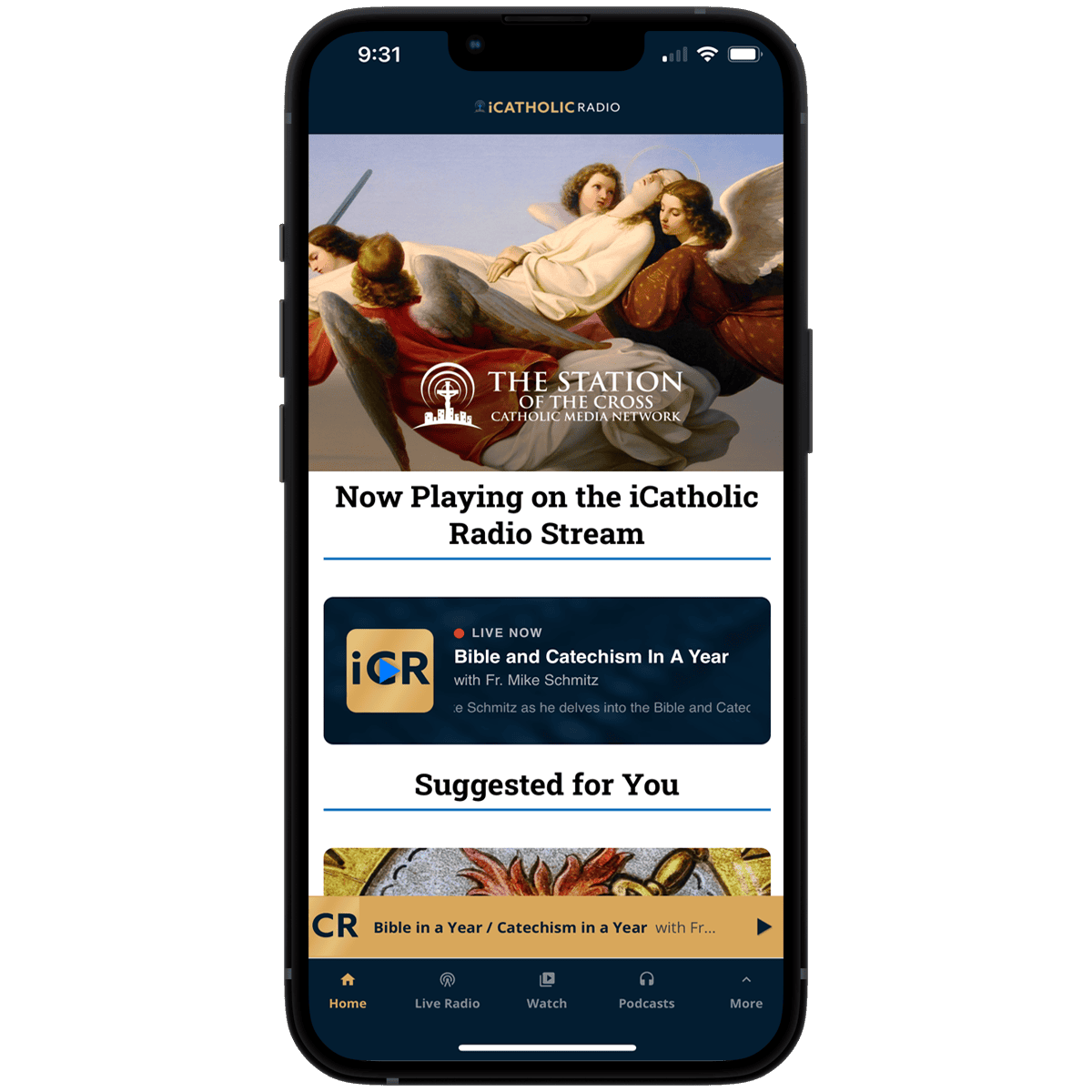
Catholic Radio, Anywhere
Faithful Catholic programming from morning to night. Watch or listen. Always free.
Get the App